EPC Rating C: What It Means, What It Costs, and How to Get There
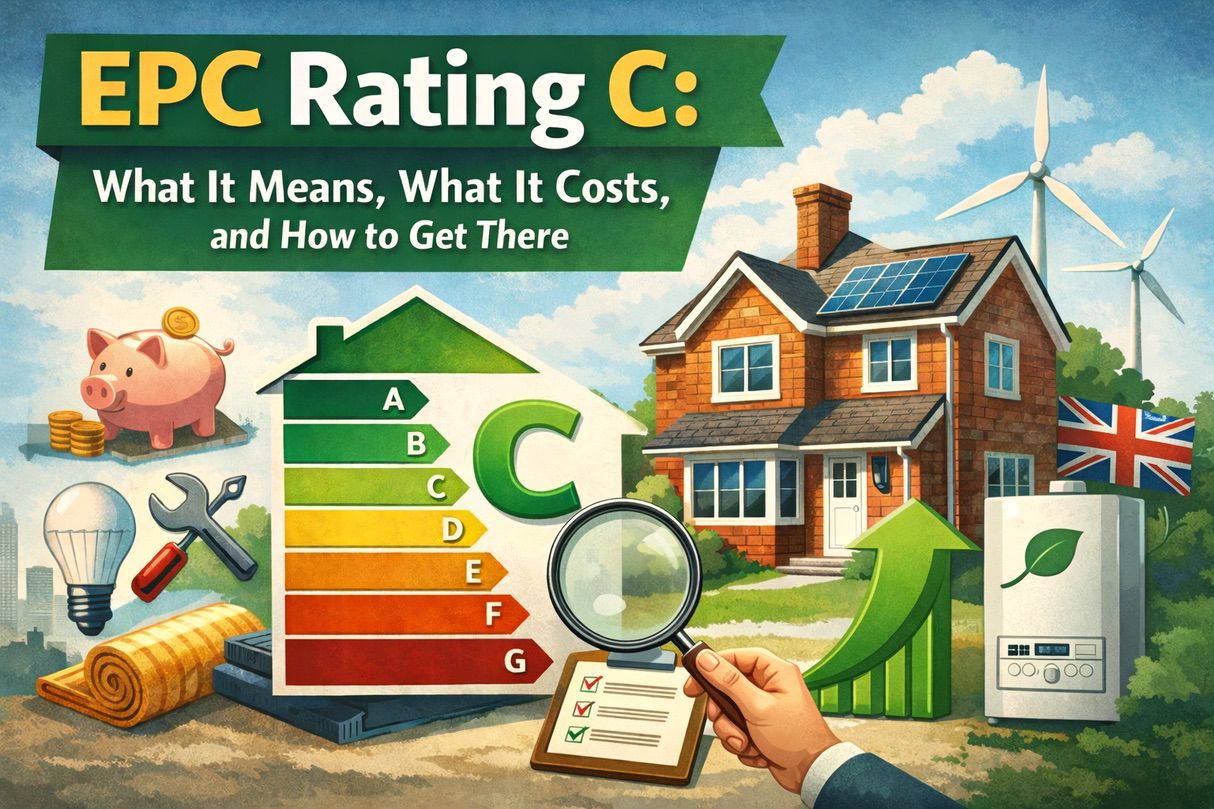
An EPC rating of C means your home scores 69–80 on the SAP scale. That puts you in the upper half for energy efficiency. It’s the benchmark the government wants all rental properties to meet, and roughly a third of UK homes already sit here.
But what does a C rating mean for your bills? Is it good enough? And if you’re stuck at D or E, how do you get there? This guide covers all of it, backed by real data from over one million EPC certificates.
In this guide
- What does EPC rating C mean?
- Is EPC rating C good or bad?
- EPC rating C monthly cost: what you’ll actually pay
- How to improve your EPC from D to C
- How to improve your EPC from E to C
- Why EPC C matters for landlords
- Going further: EPC C to B
- Frequently asked questions
What does EPC rating C mean?
EPC ratings run from A (best) to G (worst). C sits at SAP 69–80 out of 100. The average C-rated home scores about 73.
A C-rated home typically has decent insulation, a reasonably efficient heating system, and double glazing throughout. It’s not top of the scale, but it’s a well-performing property that doesn’t waste excessive energy.
| Band | SAP Score | % of UK Homes | Avg Monthly Energy Cost |
|---|---|---|---|
| B | 81–91 | 10.3% | Lower |
| C | 69–80 | 33.4% | £57 |
| D | 55–68 | 37.7% | £82 |
| E | 39–54 | 14.5% | £111 |
Monthly costs based on Heat Guide UK analysis of 1,020,472 EPC certificates. Includes heating, hot water, and lighting.
33.4% of UK homes hold a C rating. That makes it the second most common band after D (37.7%). Together, C and D account for over 70% of all homes.
Is EPC rating C good or bad?
A C rating is good. It puts your home in the top 44% for energy efficiency and meets what the government considers an acceptable standard.
| Rating | What it means |
|---|---|
| A–B | Excellent. Very low bills, typically newer builds or extensively upgraded homes |
| C | Good. Reasonable bills, meets proposed future rental standards |
| D | Average. The UK’s most common rating, scope to improve |
| E–G | Poor. High energy costs, likely needs significant upgrades |
For homeowners: you’re in a decent position. There may still be improvements worth making, particularly if you’re near the bottom of the band (SAP 69–72). But you’re unlikely to be wasting much on energy.
For landlords: a C rating is increasingly important. The government has signalled that the minimum EPC requirement for rental properties will rise from E to C. If your property already holds a C, you’re ahead of the curve.
EPC rating C monthly cost: what you’ll actually pay
Our analysis of over one million EPC certificates gives a clear picture of what each band costs in real money:
| EPC Band | Avg Monthly Energy Cost | Avg Monthly Heating Cost | Monthly Saving vs D |
|---|---|---|---|
| C | £57 | £39 | £25 saved |
| D | £82 | £63 | Baseline |
| E | £111 | £88 | £29 more than D |
A C-rated home costs £57/month on average for energy (heating, hot water, and lighting). Compare that to £82 for a D and £111 for an E.
Moving from D to C saves roughly £296/year. Moving from E to C saves about £643/year. Over a 10-year EPC validity period, that’s £3,000–£6,400 in lower energy bills.
Your actual costs depend on floor area, insulation levels, heating system, and energy tariff. But the pattern is consistent: each band improvement delivers real savings.
How to improve your EPC from D to C
D is the UK’s most common rating, covering 37.7% of homes. The good news: 87.7% of D-rated homes already have the potential to reach C or above according to their EPC assessor.
A D-rated home has a SAP score of 55–68. You need 69 to reach band C. That’s a gap of 1–14 points, depending on where you sit.
What’s holding D-rated homes back?
Our data shows the most common characteristics of D-rated properties:
| Issue | % of D-rated homes |
|---|---|
| Solid brick walls, no insulation | 37.5% |
| Cavity walls, no insulation | 19.5% |
| Cavity walls, already filled | 22.6% |
Uninsulated walls are the single biggest factor. Over half of D-rated properties (57%) have walls with no insulation, either solid brick or unfilled cavities.
The typical D-to-C upgrade path
For a D-rated home with unfilled cavity walls, the route to C is often straightforward:
| Improvement | Typical Cost | Est. SAP Gain |
|---|---|---|
| Cavity wall insulation | £500–£1,500 | 5–15 points |
| Top up loft insulation to 270mm | £100–£350 | 2–5 points |
| LED lighting throughout | £20–£50 | 1–3 points |
| Heating controls (TRVs + thermostat) | £350–£450 | 2–5 points |
| Total | £970–£2,350 | 10–28 points |
If you’re at the upper end of D (SAP 63–68), cavity wall insulation alone may be enough. The other measures give you a comfortable margin and lower bills either way.
Got solid walls instead of cavities? That changes things. Solid wall insulation costs £4,000–£14,000 but delivers 10–20+ SAP points. Check your grant eligibility first. Schemes like ECO4 and the Great British Insulation Scheme can fund insulation for qualifying homes.
How to improve your EPC from E to C
E to C is a bigger jump. You need 15–30+ SAP points. Our data shows 69.8% of E-rated homes have the potential to reach C or above, but it typically takes a combination of measures rather than a single fix.
E-rated homes (SAP 39–54) tend to have multiple problems: poor insulation, an ageing boiler, single glazing, and basic heating controls. A typical upgrade programme:
| Improvement | Typical Cost | Est. SAP Gain |
|---|---|---|
| Wall insulation (cavity or solid) | £500–£14,000 | 5–20 points |
| Loft insulation | £100–£350 | 2–5 points |
| New condensing boiler | £2,200–£3,000 | 5–10 points |
| Heating controls | £350–£450 | 2–5 points |
| Double glazing (if single glazed) | £3,300–£6,500 | 3–8 points |
| LED lighting | £20–£50 | 1–3 points |
The annual savings from E to C are substantial: £643/year on average. Lower-cost measures can pay for themselves within a few years.
Grant funding is especially relevant here. E-rated properties are more likely to qualify for ECO4 and Home Upgrade Grant support, which can cover most or all of the costs for eligible households.
Why EPC C matters for landlords
MEES currently sets the rental floor at band E. The government has clearly signalled it’s moving to C. In 2023, the NRLA reported a proposed C rating requirement with a £10,000 spending cap per property.
The exact timeline has shifted, but the policy direction hasn’t. Three things to know:
- Properties rated D or below will need upgrading. Getting ahead avoids rushed work and inflated contractor prices when every landlord is scrambling to comply.
- A C-rated property is more lettable. Tenants increasingly factor energy costs into rental decisions. Lower bills mean stronger demand.
- Mortgage lenders are watching. Some buy-to-let lenders already factor EPC ratings into lending decisions. A property that can’t meet future MEES represents a regulatory risk.
Our data shows about 39.5% of rental properties already hold a C rating. If yours doesn’t, the D-to-C improvement path above applies. Many improvements also qualify for government grants.
Going further: EPC C to B
Already at C and want to push further? Reaching B (SAP 81+) typically needs one or more high-impact measures:
| Improvement | Typical Cost | Why it helps |
|---|---|---|
| Solar PV panels | £3,500–£5,500 | Adds 5–15 SAP points; the most common EPC recommendation nationally |
| Air source heat pump | £7,000–£13,000 | Low-carbon heating is heavily rewarded by SAP; 10–20+ point gain |
| Solar water heating | £4,000–£6,000 | Cuts hot water energy demand; 3–7 SAP points |
The jump from C to B is harder than D to C because you’ve already picked the easy wins. It generally takes renewable energy (solar PV) or a switch to low-carbon heating (heat pump) to push above 80.
The Boiler Upgrade Scheme offers £7,500 towards heat pump installation. That brings a typical install down to a much more manageable figure.
Frequently asked questions
What SAP score do I need for EPC C?
69 or above. The band runs from 69 to 80. Anything above 80 is band B.
Is EPC C good enough for a mortgage?
Yes. Most lenders have no minimum EPC requirement. Some green mortgage products offer better rates for C or above. A C rating also protects the long-term mortgageability of buy-to-let properties as MEES tightens.
How much does it cost to get from D to C?
For homes with unfilled cavity walls, £1,000–£2,500 covers a typical combination of cavity wall insulation, loft insulation, and lighting upgrades. Solid-walled homes face higher costs of £4,000–£14,000 for wall insulation, though grants can cut this significantly.
Will a new boiler alone get me from D to C?
Possibly, if you’re at the upper end of D (SAP 64–68) and your current boiler is very old. A modern condensing boiler adds 5–10 SAP points. But for most D-rated homes, insulation gives better value.
Can a C-rated home have high energy bills?
Yes. The EPC rating uses standardised assumptions about occupancy and heating, not your actual usage. A C-rated home heated to 23°C in every room will cost more than a D-rated home where you’re careful with the thermostat. The rating measures the building’s potential efficiency, not how you use it.
Do I need to improve to C if I’m selling?
No. There’s no minimum EPC rating for selling, only for renting. A higher rating can still improve your sale price and make your home more attractive to buyers worried about energy costs.
What’s the difference between EPC C and D in practice?
A C-rated home costs £57/month in energy on average. A D costs £82/month. That’s a £25/month saving, or £296/year. The difference usually comes down to better insulation, a more efficient heating system, or both.
Method: Statistics in this article are based on Heat Guide UK’s analysis of 1,020,472 domestic Energy Performance Certificates across England, sourced from the DLUHC EPC register. Data accessed March 2026.
Related Guides
EPC Rating D: What It Means, What It Costs, and How to Improve
An EPC rating of D means your home has a SAP score between 55 and 68. That puts you right in the middle of the efficiency…
How to Improve Your EPC Rating: The Complete 2026 Guide
Two thirds of UK homes could have a better EPC rating right now. We analysed over one million domestic Energy Performance Certificates. 67% of properties…