How to Improve Your EPC Rating: The Complete 2026 Guide
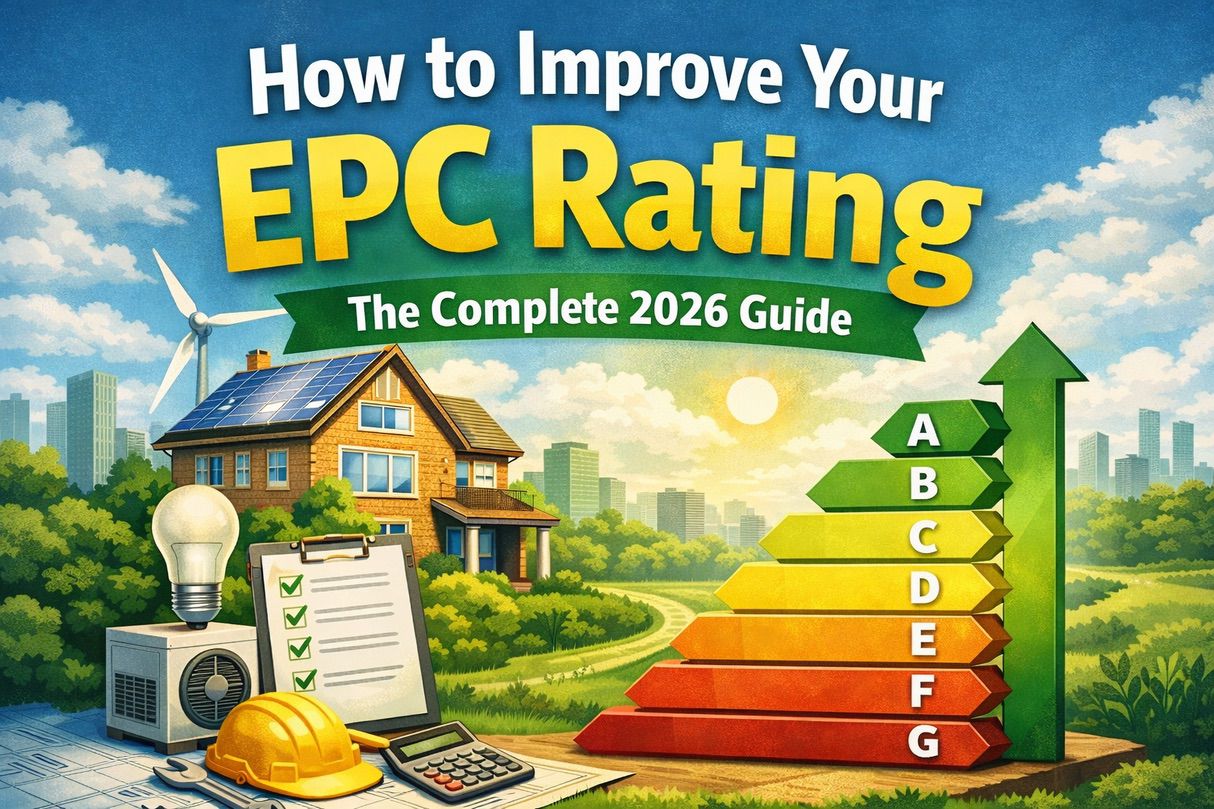
Two thirds of UK homes could have a better EPC rating right now. We analysed over one million domestic Energy Performance Certificates. 67% of properties have room to improve, and the average home could jump 1–2 bands with the right upgrades.
Whether you’re cutting energy bills, meeting landlord compliance deadlines, or pushing your landlord to act, this guide covers what to do, what it costs, and what difference it’ll make. All backed by real EPC data.
In this guide
- What is an EPC rating and how is it calculated?
- Why improving your EPC rating matters in 2026
- Quick wins: low-cost improvements (under £500)
- Medium-cost upgrades (£500–£3,000)
- Major upgrades (£3,000+)
- How to improve your EPC from D to C
- EPC improvements for landlords
- Grants and funding available
- What EPC assessors actually look at
- Frequently asked questions
What is an EPC rating and how is it calculated?
An EPC rates your home’s energy efficiency from A (best) to G (worst). It’s based on a SAP score from 1 to 100. Higher is better.
| EPC Band | SAP Score | % of UK Homes* |
|---|---|---|
| A | 92–100 | 0.3% |
| B | 81–91 | 10.3% |
| C | 69–80 | 33.4% |
| D | 55–68 | 37.7% |
| E | 39–54 | 14.5% |
| F | 21–38 | 2.9% |
| G | 1–20 | 0.9% |
*Based on Heat Guide UK analysis of 1,020,472 domestic EPC certificates across England.
D is the UK’s most common rating, covering nearly 38% of all homes. Only 44% sit at C or above, which is the standard the government is pushing towards for rental properties.
An assessor scores your home across walls, loft, floor, windows, heating system, heating controls, hot water, and lighting. Each gets a rating from Very Poor to Very Good. Together, they determine your SAP score.
Why improving your EPC rating matters in 2026
Lower energy bills. The average UK home could save £245/year by making the improvements its EPC recommends. £184 of that comes from heating alone. Over a decade, that’s nearly £2,500.
Higher property value. A 2023 DESNZ study found that improving from D to C adds 1–3% to a property’s sale price. On a £250,000 home, that’s £2,500–£7,500.
Regulatory compliance. MEES already requires rental properties to hold a minimum E rating. The government has consulted on raising this to C. Timelines have shifted, but the direction hasn’t. If you’re a landlord, act now, not when everyone else is scrambling.
Quick wins: low-cost improvements (under £500)
These cost little but can nudge your SAP score up. Sometimes that’s enough to tip you into the next band.
1. Switch to LED lighting (£20–£100)
The single most common EPC recommendation in the UK. It appears in 12% of all EPC recommendations. It’s cheap, easy, and makes a measurable difference.
34% of UK homes still have less than half their lighting as low-energy. Swapping old halogen and incandescent bulbs for LEDs costs as little as £20 for a whole house.
LEDs alone won’t jump you a full band. But they contribute SAP points that could tip a high D into a low C.
2. Draught-proofing (£100–£300)
Seal gaps around doors, windows, letterboxes, and loft hatches. DIY strips cost a few pounds. Professional draught-proofing for a whole house runs £200–£300.
Draught-proofing doesn’t always appear as a specific EPC recommendation, but it improves your heating efficiency scores. Pound for pound, it’s one of the best returns you’ll get.
3. Hot water cylinder insulation (£15–£30)
Got a hot water tank without a factory-fitted jacket? An 80mm British Standard jacket costs about £15 and saves £30–£50/year. It also boosts your SAP score under the hot water category.
4. Heating controls (£350–£450)
Heating controls appear in 3.4% of all EPC recommendations. This means a room thermostat, programmer, and thermostatic radiator valves (TRVs). If your home has basic or manual controls, upgrading adds 2–5 SAP points.
Typical cost: £350–£450 including installation.
Medium-cost upgrades (£500–£3,000)
5. Loft insulation (£100–£350)
Topping up to the recommended 270mm appears in 3.2% of all EPC recommendations. Typical cost: £100–£350. The impact can be significant, especially if you’ve got less than 100mm or old, compressed insulation.
The Energy Saving Trust estimates loft insulation saves £180–£275/year depending on property type.
6. Cavity wall insulation (£500–£1,500)
14% of UK homes with cavity walls still have no insulation. If your home was built between the 1930s and 1990s, there’s a good chance yours is one of them.
Cavity wall insulation appears in 4.5% of EPC recommendations. It costs £500–£1,500 and can improve your rating by 5–15 SAP points. For many D-rated homes, this single measure is enough to reach C.
Check your EPC report. If it says “Cavity wall, as built, no insulation”, that’s your biggest opportunity.
7. Floor insulation (£800–£1,200 for suspended floors)
Floor insulation is recommended in 8.8% of EPC reports (combining suspended and solid types). Homes with suspended timber floors, common in pre-1950s properties, can be insulated from below for £800–£1,200 if there’s cellar or crawl space access.
Solid ground floors are much pricier (£4,000–£6,000) and usually only worth doing during a bigger renovation.
8. New condensing boiler (£2,200–£3,000)
If your boiler is over 15 years old, it’s probably a non-condensing model running at 70–80% efficiency. Modern condensing boilers run at 90%+. The upgrade appears in 5% of EPC recommendations.
Cost: £2,200–£3,000 installed. Impact: 5–10+ SAP points, especially paired with better heating controls. You may qualify for a boiler grant that covers part or all of the cost.
Major upgrades (£3,000+)
9. Double or triple glazing (£3,300–£6,500)
88% of UK homes are now fully double-glazed. But 4.2% still have none at all. If that’s you, upgrading appears in 1.5% of EPC recommendations at a typical cost of £3,300–£6,500.
The SAP gain is moderate (3–8 points), but you’ll also get better comfort, less noise, and a more attractive property to buyers.
10. Internal or external wall insulation (£4,000–£14,000)
The big one for older properties. 27% of UK homes have solid brick walls with no insulation. These can’t have cavity fill. They need internal or external wall insulation (IWI or EWI).
It’s the fourth most common EPC recommendation nationally (7.2% of all recommendations). Costs range from £4,000–£14,000, but the payoff is 10–20+ SAP points.
External is less disruptive but changes your home’s appearance (and may need planning permission). Internal is cheaper but takes a few centimetres off your room sizes.
11. Solar PV panels (£3,500–£5,500)
Solar panels are the most recommended improvement on UK EPCs, appearing in 15.1% of all recommendations. A typical 2.5kWp system costs £3,500–£5,500 and adds 5–15 SAP points.
You’ll also earn from the Smart Export Guarantee (SEG). Typical payback: 8–12 years. Check if you’re eligible for a solar panel grant to cut the upfront cost.
12. Heat pump (£7,000–£13,000)
Swapping a gas boiler for an air source heat pump can transform your EPC. Heat pumps generate 3–4 units of heat per unit of electricity, and the SAP method heavily rewards low-carbon heating. Expect a 10–20+ point gain.
The Boiler Upgrade Scheme (BUS) covers £7,500 of the cost. That brings a typical installation down to a much more manageable figure.
How to improve your EPC from D to C
D is the UK’s most common rating. It’s also where most improvement journeys start, especially for landlords facing future MEES compliance.
Good news: 87.7% of D-rated homes already have the potential to reach C or above. Most won’t need every improvement on this page. A targeted combination will do it.
For a typical 1960s–1980s semi, the path looks like this:
| Improvement | Typical Cost | Est. SAP Points |
|---|---|---|
| LED lighting throughout | £20–£50 | 1–3 |
| Top up loft insulation to 270mm | £100–£350 | 2–5 |
| Cavity wall insulation | £500–£1,500 | 5–15 |
| Heating controls upgrade | £350–£450 | 2–5 |
| Total | £970–£2,350 | 10–28 |
You need a SAP score of 69 for band C. If you’re at the upper end of D (63–68), cavity wall insulation alone might get you there. The other measures give you a margin of safety and lower bills either way.
Start by checking your existing EPC report. It lists your current ratings for each element and gives specific recommendations ranked by priority. You can look it up free on the government register.
EPC improvements for landlords
If you’re a landlord, this isn’t just about savings. It’s about staying legal. MEES already requires a minimum E rating for tenanted properties. The government has proposed raising this to C.
Our data shows a clear gap between rental and owner-occupied homes. Rented properties cluster more heavily in bands D and E.
The most cost-effective approach:
- Start with your EPC recommendations. They’re ranked by cost-effectiveness. Follow the roadmap.
- Check grant eligibility. ECO4 and the Great British Insulation Scheme fund improvements for qualifying properties, especially those in lower council tax bands.
- Insulate before upgrading heating. A well-insulated home needs a smaller heating system. You’ll get a bigger rating jump per pound spent.
- Keep records. If you’ve spent £3,500 (inc. VAT) on improvements and still can’t hit the minimum rating, you can register an exemption. But you’ll need documentation.
Grants and funding available
You may not need to pay for everything yourself. These government schemes can help:
| Scheme | What It Covers | Who’s Eligible |
|---|---|---|
| ECO4 Scheme | Insulation, heating, solar. Fully funded | Low-income households, benefits recipients |
| Great British Insulation Scheme | Cavity wall, loft, underfloor insulation | Council tax bands A–D (England), benefits recipients |
| Boiler Upgrade Scheme | £7,500 towards heat pump installation | Homeowners with valid EPC, replacing fossil fuel heating |
| Home Upgrade Grant (HUG2) | Insulation, clean heating for off-gas homes | Low-income households in homes rated D–G, no mains gas |
Read our full guides on each scheme, or use our grant eligibility checker to see what’s available for your property.
What EPC assessors actually look at
Knowing how the assessment works helps you prepare and avoid surprises.
| Element | What They Check | Impact on Rating |
|---|---|---|
| Walls | Construction type, insulation present | Very High |
| Roof/loft | Insulation depth and type | High |
| Floor | Insulation type (if accessible) | Moderate |
| Windows | Single, double, or triple glazing | Moderate |
| Main heating | Boiler type, age, efficiency | Very High |
| Heating controls | Thermostat, programmer, TRVs | Moderate |
| Hot water | Cylinder insulation, controls | Low to Moderate |
| Lighting | % of low-energy fittings | Low |
| Renewables | Solar PV, solar thermal | High |
One thing to know: assessors can only record what they can see evidence of. If you’ve had cavity wall insulation installed but can’t show the guarantee certificate, it may go down as “no insulation (assumed).” Keep your paperwork.
Frequently asked questions
How much does it cost to improve an EPC rating?
Depends on your starting point. Most D-rated homes can reach C for £1,000–£2,500 with insulation and heating controls. Solid-walled homes face higher costs, typically £5,000–£15,000 for wall insulation alone.
Can I improve my EPC rating without spending money?
Not really. The rating reflects your home’s physical characteristics, not your behaviour. But if you’ve already had work done since your last EPC (new boiler, insulation, etc.), a fresh assessment could show a higher rating without any new spend.
How long does it take to get a new EPC?
The assessment takes 45–90 minutes and costs £60–£120. You’ll usually have the certificate within 24–48 hours. It’s valid for 10 years.
Does a new kitchen or bathroom improve my EPC?
No. EPCs only look at the thermal envelope (walls, roof, floor, windows) and heating systems. Cosmetic work doesn’t affect your rating.
Will a smart thermostat improve my EPC?
Maybe. The SAP assessment recognises certain heating controls: programmers, room thermostats, TRVs. A smart thermostat may count, but only if it’s on the SAP product register. Check with your assessor first.
What’s the difference between current and potential EPC rating?
Your current rating is your home as it stands. Your potential rating is what you’d get by following the recommended improvements. 67% of homes have a potential rating higher than their current one, with an average gap of 1.6 bands.
Do I need an EPC to sell or rent my home?
Yes. You need a valid EPC (under 10 years old) when selling, renting, or building. No EPC means a fine. Landlords also need to meet MEES minimum rating requirements.
Check what grants you’re eligible for
Answer a few questions about your home and we’ll show you which government schemes could fund your improvements for free. Check your eligibility →
Method: Statistics in this article are based on Heat Guide UK’s analysis of 1,020,472 domestic Energy Performance Certificates and 3,651,331 recommendations across England, sourced from the DLUHC EPC register. Data accessed March 2026.
Related Guides
EPC Rating D: What It Means, What It Costs, and How to Improve
An EPC rating of D means your home has a SAP score between 55 and 68. That puts you right in the middle of the efficiency…
EPC Rating C: What It Means, What It Costs, and How to Get There
An EPC rating of C means your home scores 69–80 on the SAP scale. That puts you in the upper half for energy efficiency. It's…