EPC Rating D: What It Means, What It Costs, and How to Improve
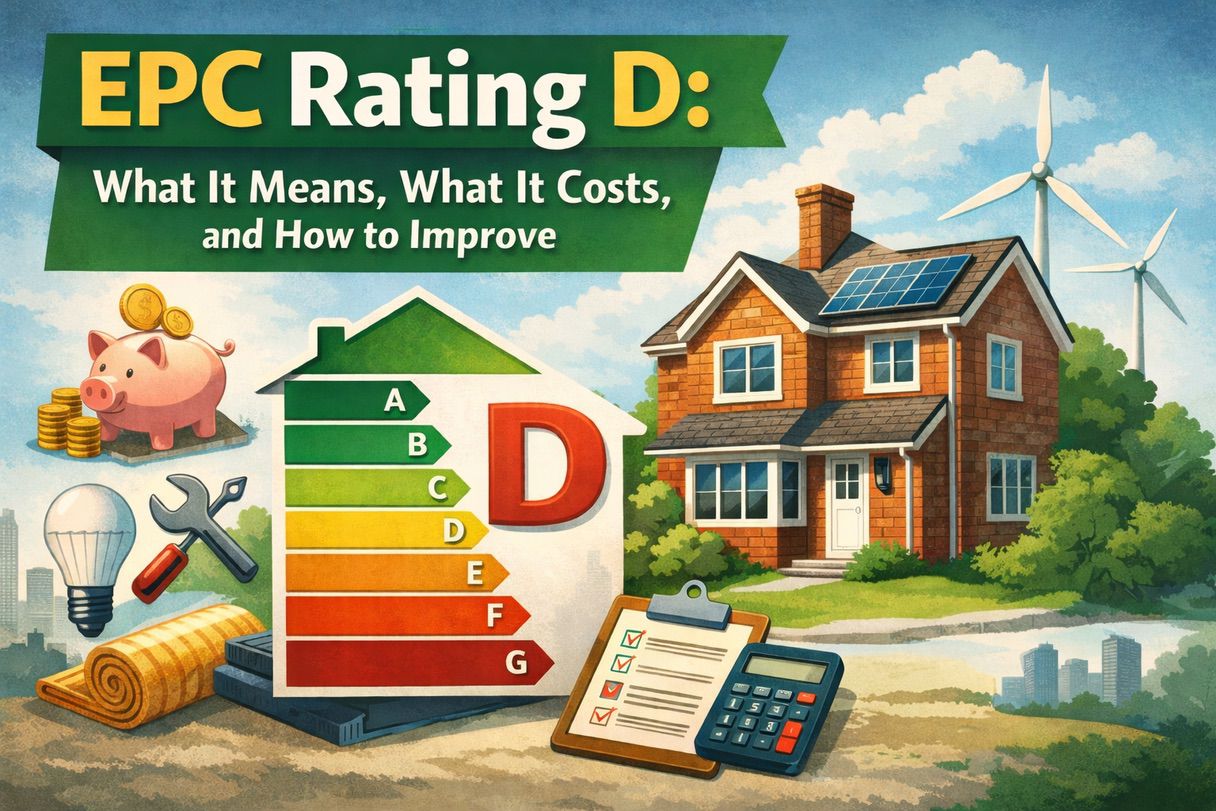
An EPC rating of D means your home has a SAP score between 55 and 68. That puts you right in the middle of the efficiency scale. It’s the UK’s most common rating, covering 37.7% of all homes. And the good news is that 87.7% of D-rated properties already have the potential to reach C or above.
But what does a D rating actually cost you each month? Is it bad? And what’s the most cost-effective way to improve? This guide answers all of that with real data from over one million EPC certificates.
In this guide
- What does EPC rating D mean?
- Is EPC rating D good or bad?
- EPC rating D monthly cost
- Why is my home rated D?
- How to improve your EPC from D to C
- What EPC D means for landlords
- Does EPC D affect property value?
- Frequently asked questions
What does EPC rating D mean?
EPC ratings run from A (best) to G (worst). D sits at SAP 55–68 out of 100. The average D-rated home scores 62.
A D-rated home is middle of the pack. It typically has some insulation, a gas boiler, and double glazing, but at least one major element is underperforming. That could be uninsulated walls, an old boiler, or poor heating controls.
| Band | SAP Score | % of UK Homes | Avg Monthly Energy Cost |
|---|---|---|---|
| B | 81–91 | 10.3% | £38 |
| C | 69–80 | 33.4% | £57 |
| D | 55–68 | 37.7% | £82 |
| E | 39–54 | 14.5% | £111 |
| F | 21–38 | 2.9% | £149 |
Monthly costs based on Heat Guide UK analysis of 1,020,472 EPC certificates. Includes heating, hot water, and lighting.
37.7% of UK homes hold a D rating. That makes it the single most common band, ahead of C (33.4%) and E (14.5%). If your home is rated D, it’s in the majority.
Is EPC rating D good or bad?
D is average. It’s not terrible, but it’s not good either. You’re paying more than you need to on energy, and there’s almost certainly room to improve.
| Rating | What it means |
|---|---|
| A–B | Excellent. Very low bills, typically newer builds or extensively upgraded homes |
| C | Good. Reasonable bills, meets proposed future rental standards |
| D | Average. The UK’s most common rating. Room to improve |
| E–G | Poor. High energy costs, likely needs significant upgrades |
The real issue with D is what’s coming. The government has signalled that the minimum EPC for rental properties will rise from E to C. If you’re a landlord with a D-rated property, you’ll eventually need to upgrade. If you’re a homeowner, improving to C could save you hundreds per year and add value to your property.
87.7% of D-rated homes already have the potential to reach C or above based on their EPC assessor’s calculations. For most, the improvements are straightforward and cost-effective.
EPC rating D monthly cost: what you’ll actually pay
Our analysis of over one million EPC certificates breaks down the real costs by band:
| EPC Band | Avg Monthly Energy Cost | Avg Monthly Heating Cost | Difference vs D |
|---|---|---|---|
| B | £38 | £18 | £44 less |
| C | £57 | £39 | £25 less |
| D | £82 | £63 | Baseline |
| E | £111 | £88 | £29 more |
| F | £149 | £116 | £67 more |
A D-rated home costs £82/month on average for energy (heating, hot water, and lighting). That’s £25 more per month than a C-rated home and £44 more than a B.
Improving from D to C saves roughly £296/year. Over a 10-year EPC validity period, that’s nearly £3,000 in lower energy bills. If you could reach B, the saving jumps to £528/year.
The average D-rated home could save £265/year by making all the improvements its EPC recommends. That’s based on real EPC data, not estimates.
Why is my home rated D?
D-rated homes aren’t all the same. But our data shows clear patterns in what’s holding them back.
Walls are the biggest factor
61.4% of D-rated homes have walls rated Poor or Very Poor. Compare that to just 16.6% of C-rated homes. Walls are the single biggest reason most D-rated properties haven’t reached C.
| Wall type | % of D-rated homes |
|---|---|
| Solid walls, no insulation | 38.0% |
| Cavity walls, no insulation | 29.0% |
| Cavity walls, filled | 29.9% |
67% of D-rated homes have uninsulated walls. That’s either solid brick (38%) or unfilled cavities (29%). If your home has uninsulated walls, that’s almost certainly what’s keeping you in band D.
The typical D-rated home
Our data paints a clear profile of the average D-rated property:
- Built before 1966. 72% of D-rated homes were built before 1966. A quarter date from 1900–1929
- Mostly houses. 71% are houses, 23% are flats
- Gas heated. 87% use mains gas as their primary fuel
- Double glazed (mostly). 85% are fully double glazed, but 4.1% still have none
- Poor lighting efficiency. 37.5% have less than half their lighting as low-energy
The pattern is consistent: D-rated homes tend to be older properties that have had some upgrades (double glazing, maybe a boiler replacement) but haven’t addressed the walls or smaller efficiency measures like lighting and heating controls.
How to improve your EPC from D to C
You need a SAP score of 69 to reach band C. The average D-rated home sits at 62, so you’re looking at a gap of about 7 points. Some homes near the top of the band (SAP 65–68) only need 1–4 points.
87.7% of D-rated homes can reach C or above. 45.2% can reach B. The potential is there for the vast majority.
If you have unfilled cavity walls
This is the easiest route. 29% of D-rated homes have cavity walls with no insulation. Getting them filled is quick, cheap, and often enough on its own to reach C.
| Improvement | Typical Cost | Est. SAP Gain |
|---|---|---|
| Cavity wall insulation | £500–£1,500 | 5–15 points |
| Top up loft insulation to 270mm | £100–£350 | 2–5 points |
| LED lighting throughout | £20–£50 | 1–3 points |
| Heating controls (TRVs + thermostat) | £350–£450 | 2–5 points |
| Total | £970–£2,350 | 10–28 points |
If you’re at the upper end of D (SAP 63–68), cavity wall insulation alone might get you there. The other measures give you a comfortable margin and lower bills either way.
If you have solid walls
38% of D-rated homes have solid brick walls. These can’t be cavity-filled. You need internal or external wall insulation (IWI or EWI), which costs £4,000–£14,000 but delivers 10–20+ SAP points.
That’s a bigger investment. But grant schemes like the Great British Insulation Scheme can fund insulation for qualifying homes, especially those in council tax bands A–D. Check your eligibility before committing to the full cost.
Top EPC recommendations for D-rated homes
The most common EPC recommendations for D-rated properties, based on 1.7 million data points:
| Recommendation | % of D-rated homes | Typical Cost |
|---|---|---|
| Solar PV panels | 68.9% | £3,500–£5,500 |
| Low energy lighting | 50.8% | £20–£100 |
| Internal or external wall insulation | 36.3% | £4,000–£14,000 |
| Floor insulation (suspended) | 26.1% | £800–£1,200 |
| Cavity wall insulation | 22.3% | £500–£1,500 |
| New condensing boiler | 21.3% | £2,200–£3,000 |
| Loft insulation top-up | 14.9% | £100–£350 |
| Heating controls | 10.9% | £350–£450 |
Solar PV tops the list because the SAP method heavily rewards onsite generation. But for pure cost-effectiveness, start with the cheaper measures: lighting, loft insulation, cavity wall insulation, and heating controls. These give the best return per pound.
What EPC D means for landlords
Right now, a D rating is legal for rental properties. MEES currently requires a minimum of E. But the government has proposed raising this to C, with a £10,000 spending cap per property.
The exact timeline has shifted, but the direction hasn’t. If you’re a landlord with a D-rated property, you will need to upgrade at some point.
Our data shows that about 49% of D-rated homes are rented (combining private and social tenancies). That’s nearly half the band that will eventually need to reach C.
Three reasons to start now:
- Avoid the rush. When the deadline hits, every landlord will be competing for the same installers. Prices go up, availability goes down
- Attract better tenants. Energy costs matter to renters. A C-rated property with lower bills is more appealing than a D
- Protect your mortgage. Some buy-to-let lenders already factor EPC ratings into lending decisions. A property that can’t meet future MEES represents a regulatory risk
The typical D-to-C upgrade costs £1,000–£2,500 for cavity wall homes. That’s well within the proposed £10,000 cap and pays for itself in lower void periods and higher rental demand.
Does EPC D affect property value?
Yes. A 2023 DESNZ study found that improving from D to C adds 1–3% to a property’s sale price. On a £250,000 home, that’s £2,500–£7,500.
Buyers are increasingly aware of energy costs. A D rating signals higher bills and potential upgrade costs. A C rating signals an efficient, future-proofed home.
Even if you’re not selling soon, the investment in reaching C is likely to return more than it costs through a combination of lower bills (£296/year) and higher property value.
Frequently asked questions
What SAP score do I need for EPC D?
55 to 68. Anything below 55 is band E. Anything 69 or above is band C.
How much does it cost to go from D to C?
For homes with unfilled cavity walls, £1,000–£2,500 covers a typical combination of cavity wall insulation, loft insulation, and lighting upgrades. Solid-walled homes face higher costs of £4,000–£14,000 for wall insulation, though grants can cut this significantly.
Can I rent out a D-rated property?
Yes, currently. MEES requires a minimum E rating, and D exceeds that. But the government has proposed raising the minimum to C. When that happens, D-rated rental properties will need to be upgraded or an exemption registered.
Will a new boiler get me from D to C?
Possibly, if you’re at the upper end of D (SAP 64–68) and your current boiler is very old. A modern condensing boiler adds 5–10 SAP points. But for most D-rated homes, insulation gives better value per pound spent.
Is EPC D bad for a mortgage?
Not currently. Most lenders have no minimum EPC requirement. Some green mortgage products offer better rates for C or above, so improving could save you on your mortgage rate too. For buy-to-let, a D rating may become a concern as MEES tightens.
Why is my EPC D when I have double glazing?
Double glazing alone isn’t enough for C. 85% of D-rated homes are already fully double-glazed. The bigger factors are wall insulation, boiler efficiency, and heating controls. If your walls have no insulation, that alone can keep you in band D regardless of your windows.
What’s the difference between D and C in real terms?
A D-rated home costs £82/month in energy on average. A C costs £57/month. That’s £25/month, or £296/year. The main difference between the two bands is wall insulation quality: 61.4% of D-rated homes have poor walls compared to just 16.6% of C-rated homes.
Method: Statistics in this article are based on Heat Guide UK’s analysis of 1,020,472 domestic Energy Performance Certificates and 1,704,518 recommendations for D-rated homes across England, sourced from the DLUHC EPC register. Data accessed March 2026.
Related Guides
EPC Rating C: What It Means, What It Costs, and How to Get There
An EPC rating of C means your home scores 69–80 on the SAP scale. That puts you in the upper half for energy efficiency. It's…
How to Improve Your EPC Rating: The Complete 2026 Guide
Two thirds of UK homes could have a better EPC rating right now. We analysed over one million domestic Energy Performance Certificates. 67% of properties…